The life of our revered father , Pimen the Merciful .
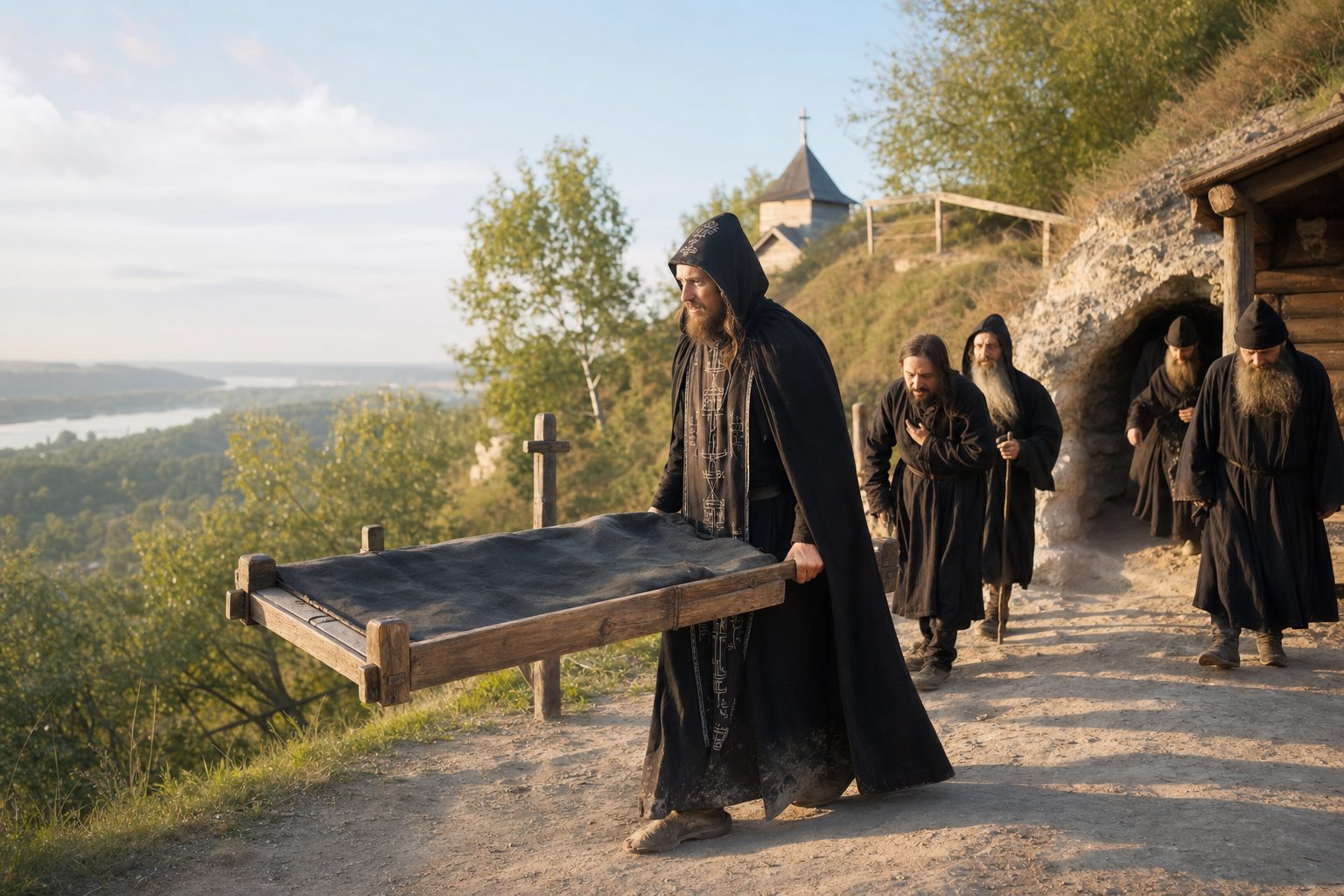
Coming to the story of Blessed Pimen, let us focus on his great courage in suffering and learn from this that sickness must be endured patiently and that God's power is made perfect in weakness.
<unk> The blessed Pimen was born sick; the disease did not leave him all his life, but this illness of the body did not cause him to develop a mental illness: he was pure of defects and kept his virginity from his mother's womb.
He repeatedly asked his parents to allow him to retire to a monastery to be shaved into a pagan image, but out of a strong love for him they refused these requests, wishing to have him as an heir upon his death.
One day, by the action of the Divine Providence, which arranges everything for the best, blessed Pimen became especially ill, so that he did not even hope for recovery; obeying the need, his parents brought him to the Cave Monastery.
Prince Izyaslav (1054-1068).] and asked the holy fathers who lived there to pray for the deliverance of their son from illness.
But the fervent prayers of the monks did not bring healing to the sick; the prayer of the blessed was stronger than the prayers of all of them, for he asked the Lord for even more sickness for himself, for he feared that, when he recovered, his parents would again take him out of the monastery and thus deprive him of the opportunity to get a haircut.
Therefore, when his father and mother sat beside him, not allowing him to cut his hair [Cutting hair into paganism has been performed by the holy Orthodox Church since ancient times in a special way over those who choose the path of martyrdom and total dedication to God in prayer and repentance.
The candidate is asked whether he chooses this path freely, then he is obliged to make three vows: virginity, chastity and poverty, after which, in the name of the Holy Trinity, his hair is cut in the form of a cross and he is clothed in monastic garments.
The newly-cut is given a crucifix and a candle in his hand.] , blessed Pimen was very sad and prayed to God that he would fulfill his desire, which he knows the ways.
And it came to pass one night, when his parents and his servants were sound asleep, that there came unto him bright angels, some in the form of fair youths, and others of priests and brothers, bearing in their hands the holy Gospel, and candles, and a candle, and a cloak, and a doll, and all that was necessary for the cutting of hair.
And they said to him, Shall we cut off thy hair? And he said, I will; for the Lord has sent you, my lords.
And they made him a great image, and clothed him with a robe, and put a crown upon him, and gave him the name Pimen, and a candle,
And they said unto him, Thou shalt not die: forty days and forty nights shall the candle burn; and they foretold him a continual sickness, and that his recovery from it would be a sign of his impending death.
Feodosius, the closest companion of Antony, was later the abbot of the Kiev Cave Monastery.
The monks who were in the nearby cells, hearing the singing, woke the others, thinking that either the abbot with some of the brothers was cutting the sick man's hair, or he had recovered; they all went together to the cell where the monk lay.
And they found all of them asleep, father, mother, and servants; and the nuns awoke them, and saw that the cell was full of fragrance, and the sick man was full of joy and gladness, and clothed with other garments.
"Who shaved your head?" they asked. "What kind of music did we hear here that your parents didn't hear?"
"I think", he replied, "that I was shaved by Pimen, the abbot who came here with his brothers; and they sang as you heard; and they gave me this candle that you see, saying that it would burn continuously for forty days and forty nights; and then, putting my hair in the sheath, they withdrew from
I'm taking them to church.
When the nuns heard this, they rushed to the church, but found it locked. They woke the monks and asked them if anyone had entered the church after evening prayers.
They replied that no one had entered, since the keys themselves were with the ecclesiastic [a church locksmith who is entrusted with the care of church property and who has the responsibility of overseeing the execution of church worship].
The ecclesiastic was awakened (he did not give the keys to anyone and he himself did not enter the church with anyone); taking the keys, the monks entered the temple and here on the coffin of St. Theodosius they really found the hair lying in the brush.
And the king was exceedingly astonished, and sought diligently to cut off the hair of Pimen, but he could not; and it was plain to all that the cutting was done by the holy angels by the commandment of God.
The abbot and the brethren discussed for a long time whether the miraculous circumcision should be performed as was customary, and they decided not to repeat the circumcision on the blessed Pimen, since there were clear evidences of the reality of what had been done on him.
His hair on the coffin of St. Theodosius, and a candle, for which it was enough for a day to burn, for forty days and nights burned, not extinguished [The number forty has an important symbolic meaning.
It signifies the transition from one state to another, the renewal, the change. After forty days of birth, the infant is brought to the church to be consecrated to God.
The newly ordained monk must be especially active in prayer, as he is as if born for a new life, and as if dead for the earthly and transitory.
And they said unto him, Brother Pimen, thy countenance and thy name, which God hath given thee, is enough.
And when the priest brought the book of the law, he said, Tell us, we pray thee, who it was that cut thee, and did not take away that which was written in the book. And the priest said, Why doest thou test me, father?
Thou hast come here with all thy brethren, and hast done unto me all that is written in this book, and hast said that all my life I must suffer the affliction of this sickness, and that only before death shall I be delivered from it, that I may be able to bear my death-bed: pray for me, holy father, that the Lord
He gave me patience.
So they all left him. He was bedridden for three days, not eating or drinking, and all his servants despised him.
It happened that one patient, suffering from the same disease as the monk Pimen, was brought to the Cave Monastery and was shaved.
The monks, who had the duty of ministering to the sick, brought him to the blessed Pimen to minister to both of them together and equally, but neglecting their duties, they partly forgot about them, so that the sick at times fainted from thirst.
Then blessed Pimen said to the sick man who lay with him, "Since our servants abhor us because of the stench that comes from us, would you, my brother, want to bear their burden if the Lord restored you?"
The patient promised to serve the monk with diligence until death.
And when thy Lord hath removed thy sickness from thee, and thou art well, and thou art sound in thy word, then serve me and my followers. And those who are negligent in their duty, their Lord will punish them with a painful sickness, that they may taste the chastisement and be saved.
The sick man immediately got up and began to minister to the monk; but the negligent servants, he said, were overcome by the disease.
Suddenly, he was seized by a fever, and he was unable to stand for three days. Finally, he cried out: "Have mercy on me, for I am dying of thirst".
When the relatives of the prisoner heard about him, they went to see him and told the priest Pimenus about her: "Your brother's servant is dying".
"What a man sows, that he shall reap", replied the monk (cf. Gal. 6:7): he left me hungry and thirsty, and he himself endured the same thing. lying to God and despising my unworthiness.
And the man was instantly healed, and rose up, and went to the priest without help. And the blessed Pimen said unto him, Little faith, thou art healed; rise up, and sin no more.
The patience of the humble will not be in vain: those who experience brief sorrow and sorrow here will experience joy and joy where there is no sickness, no sorrow, no sighing, but eternal life.
For this reason I endure all things. God, who through me has saved you from your infirmity, can also raise me from this bed and heal my infirmity. But I do not want that. "But he who has endured to the end will be saved", said the Lord.
I'd rather be dead in this life, so that my body would be incorruptible, or rather suffer here, so that there would be an ineffable fragrance.
Majestic, my brother, a church service in a bright, pure and holy place, where it is pleasing and sweet with invisible angelic powers to pray to God, why the church is called earthly heaven, and those who stand in it are honored as those who stand in heaven.
Is not this dark and smelly prison a place of judgment, a place of eternal torment?
(Ps. 39:2) Comforting such sufferers, the apostle says: "If you endure discipline, God is treating you as sons . . .
If you are not disciplined, which all share, then you are illegitimate children and not sons". (Heb. 12:7-8) And the Lord himself admonishes us, "By endurance you will acquire your souls". - Luke 21:19.
Impressed by this admonition of the saint, the brother did not abandon him, serving him; while the valiant sufferer and true imitator of the righteous Job, Saint Pimen lay on his bed of illness for twenty years, continuously thanks to God.
When the time came for his departure, a sign appeared in the Cave Monastery: three pillars of fire appeared over the dining room at night, which then moved to the top of the church.
The Lord alone knew the true meaning of this sign, but it would not be unjust to suppose that through it it was shown that the Triune God, who "creates his angels spirits, his ministers <unk> flaming fire" (Ps 103:4), had already sent down his angels after the soul of the agonized man, as if for the sake of the Holy Spirit.
Lazarus' soul: that day, he suddenly recovered and learned that his death was imminent, remembering the prediction of those who shaved him.
He stood up and walked around the cell, and then he said to the sick men, "Brothers and sisters, get up!" Immediately their leprosy left them, and they were healed.
The Reverend Pimen, entering the church, received the Divine Mysteries, and afterwards, taking his deathbed, carried it, without any instructions, to a cave in which he had never been, which he had never seen since his birth.
Upon entering the cave, he bowed to the coffin of St. Anthony [The remains of St. Anthony (died 1073) rest under the bottom of the cave where he was buried (in the so-called Near Caves).] and indicated the place where he wished to be buried.
Before his death, he told a wonderful secret, pointing to the coffins of some of the brothers lying nearby: <unk> Here, <unk> he said, <unk> you laid this year two brothers, one without a shroud, and the other in a shroud [The shroud is a garment of the highest degree of monasticism, which is called the Archangel image.
During the haircut, the monk also wears some special clothes, namely: a doll and analav.
The doll is a garment that covers the head and shoulders from all sides: it has a somewhat pointed top and is decorated with five crosses, embroidered with red cords; these crosses are located: on the forehead, on the chest, on both shoulders and on the back.
He descends from the top of the neck on the shoelaces and splits to the sides, embraces the muscles under the arms and, positioned in a cross-shaped manner on the chest and shoulders, wraps and pulls the clothes with the same shoelaces.
And the first, which was laid without frame, ye shall find in the frame; and he would have received it many times, but he put it off; but because he had done works worthy of the type, the Lord gave him the frame unto death.
And another brother, who is laid in the shrine, you shall find without her. He did not want the shrine while he was alive, nor did he show the works worthy of it, but said, When you see that I am leaving this world, then cut me in the shrine. He did not remember the words of the one who said, "Not the dead will praise the Lord, nor all those who descend into the grave.
Let us praise the Lord.
Whoever has will be given more, and he will have an abundance. Whoever does not have, even what he has will be taken from him".
The third brother, he continued, was laid here many years ago, and is all rotten, but his frame remains uncorrupted, and is reserved for his condemnation and rebuke, because he has done things unworthy of the image, and has spent his whole life in idleness and sin, not remembering the words of the Lord.
(Luke 12:48); shaving in the foreskin does not benefit those who do not do good works that save them from eternal torment.
When the secret was revealed, Saint Pimen said to his brothers: "Those who cut my hair have come to take my soul". Immediately after these words he stood up and prayed to the Lord [February 11, 1110].
<unk> After excavating the coffins that the monk had told them about, they found, according to his words, three black-haired men: of the two, who had recently died, one was buried in a shrine, was deprived of it, <unk> it was entrusted to another, who did not have it; the third brother, who had long since died, was found completely decayed, but only one.
His scheme was intact.
And they marveled at God's ineffable judgment, for he will repay every man according to his deeds. Glory and honor and power be to God, now and forevermore. Amen.